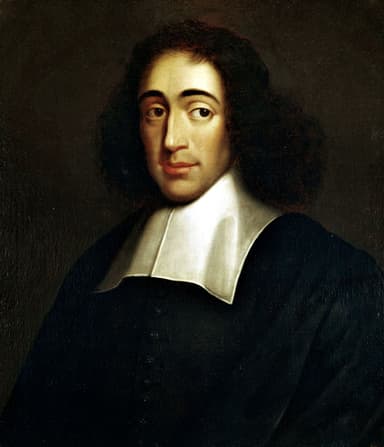
Spinoza
1632–1677
Philosophy as formal system
Author of the Ethics, Demonstrated in Geometrical Order. Spinoza was the first philosopher to write a complete philosophical system in axiomatic form: definitions, axioms, propositions, demonstrations, corollaries. It is the structure of Euclid applied to metaphysics, ethics, and human nature.
The Precedent
Lucidosophy is the most direct intellectual descendant of Spinoza's Ethics. Both share the same structural ambition: take the axiomatic method from mathematics and apply it to the deepest questions about reality, knowledge, and human life. Spinoza proved that this was not absurd: philosophy could be rigorous without ceasing to be philosophy. Lucidosophy takes this precedent seriously and extends it: where Spinoza had one substance (God/Nature), Lucidosophy has Reality; where Spinoza had two attributes (Thought and Extension), Lucidosophy has Pattern and Mystery.
Monism
Spinoza's central claim, that there is only one substance and everything is a mode of that substance, maps directly to Lucidosophy's Postulate One. "All that exists is a mode of Reality's unfolding. Nothing exists outside Reality." This is Spinoza's monism expressed in the framework's own language. The parallel is not accidental: the same structural conclusion appears in two traditions with very different starting points, 17th-century European rationalism and Laozi's Tao Te Ching, and Lucidosophy draws on both. The Institute reads that convergence as a reason to take the insight seriously, not as a proof of it.
What Lucidosophy Adds
Spinoza could not formally verify his proofs: the "geometrical order" of the Ethics is a literary and logical structure, not a machine-checkable one. Lucidosophy adds two things Spinoza did not have: first, Cognitive Finitude (Postulate Six) and the Self-Reference Theorem it grounds (T3, with Postulate Three), which apply the framework's limits to the framework itself. Spinoza's system, which claimed completeness, did not do this. Second, LucidoMath, a formal verification library that checks the framework's mathematical claims with a proof kernel. The Ethics inspired the form; for the mathematical part, the Institute builds the verification Spinoza could only gesture at. The postulates themselves remain philosophical commitments, not theorems.
Connected Postulates