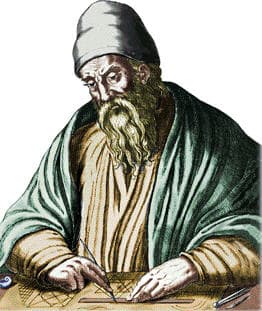
Euclid
c. 300 BC
The axiomatic method
Author of the Elements, the most influential mathematics text in history. Euclid demonstrated that a vast body of geometric knowledge could be derived from a small set of postulates and common notions through rigorous deduction.
The Postulate-Driven Method
Lucidosophy adopts Euclid's architecture directly: start from a small set of foundational postulates, then derive everything else. The Elements begins with 5 postulates and 5 common notions; Lucidosophy begins with 6 postulates. In both cases, the ambition is the same: build a coherent system where every claim can be traced back to its foundations. The word "postulate" in the Institute's vocabulary is a deliberate echo of Euclid.
From Euclid to LucidoMath
Euclid's proofs were written in natural language and relied on human readers to verify each step. LucidoMath takes the Euclidean ideal to its logical conclusion: every proof is checked by a machine kernel that cannot be persuaded, only satisfied. Where Euclid trusted his readers' geometric intuition, LucidoMath trusts nothing but the axioms and the rules of inference. The result is the same structure of postulates, definitions, theorems, and proofs, but with a guarantee Euclid could not provide: a proof that builds is a proof that holds.
The Fifth Postulate Problem
Euclid's parallel postulate, the famous fifth, stood for two millennia as a reminder that not all postulates are equally self-evident, and that questioning them can open new worlds (non-Euclidean geometry). Lucidosophy inherits this lesson through its self-correction principle (Ethical Proposition EP6): the framework is designed to be challenged. Chapter XIX.1 tests the six postulates for independence and minimality, and states that if one turns out to be derivable from the others, it should be demoted to a theorem rather than defended; if one turns out to be wrong, the system is built to accommodate revision. The Institute treats its own postulates with the same seriousness and the same openness that mathematicians eventually brought to Euclid's fifth.
Connected Postulates