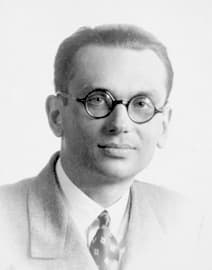
Gödel
1906–1978
The limits of formal systems
Proved the incompleteness theorems: any sufficiently powerful consistent formal system contains true statements it cannot prove, and cannot prove its own consistency. These results permanently changed our understanding of the relationship between truth, proof, and formal systems.
Cognitive Finitude as Postulate
Gödel proved that no consistent, effectively axiomatized formal system strong enough for arithmetic can prove every arithmetical truth, nor prove its own consistency from within. Lucidosophy's Postulate Six ("Any mode of Reality's unfolding can only partially know Reality") states a parallel limit for knowers, and the Self-Reference Theorem (T3), derived from Postulates Six and Three, is what the book calls the ontological generalisation of Gödel's insight: no sufficiently rich axiomatic system can fully describe the reality it inhabits. This is a philosophical extension by analogy, not a consequence of Gödel's theorems: where Gödel's result is a proof about formal arithmetic, Lucidosophy postulates that any finite perspective on reality is incomplete. The Institute treats this not as a defeat but as a structural feature of reality itself.
Honest Scope in LucidoMath
Gödel's theorems inform LucidoMath's core design principle: be as careful about what you do not prove as about what you do. LucidoMath's honest status taxonomy (proved, axiom-audit, resolved) is informed by the Gödelian insight. A verification engine that claims to prove everything is lying; one that clearly marks the boundary between what it has proved and what it has not is telling the truth. LucidoMath refuses to dress philosophical assertions in the costume of theorems, in the spirit of Gödel's lesson that provability has limits.
Beyond Incompleteness
Gödel himself believed in mathematical Platonism: the view that mathematical truths exist independently of our ability to prove them. Lucidosophy's Postulate Three (Dual Aspect) resonates with this: Pattern exists as an aspect of Reality, whether or not we have formalised it. The incompleteness theorems do not say truth is inaccessible; they say no single formal system can access all of it. This is exactly the Institute's position: we build formal systems (LucidoMath), we push them as far as they go, and we acknowledge that Reality is always greater.
Connected Postulates