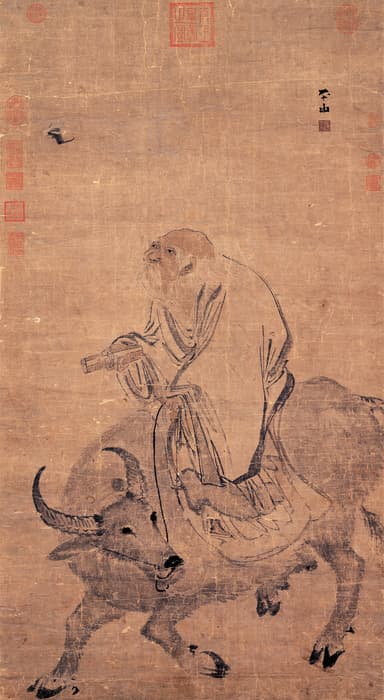
Laozi
c. 6th century BC
The origin of Tao
Author of the Tao Te Ching, the foundational text of Taoist philosophy. Laozi articulated the concept of Tao as the unified, ineffable ground of all reality, and the interplay between what can be named and what cannot.
From Tao to the First Postulate
Lucidosophy's Postulate One states: "There exists a unified ground of reality. All that exists is a mode of Reality's unfolding. Nothing exists outside Reality." The insight descends directly from Laozi. The Tao Te Ching opens with "The Tao that can be spoken is not the eternal Tao". The line names a nameless ground and, in the same breath, marks the impossibility of fully capturing it in language. Lucidosophy inherits that gesture and makes it structural: what Laozi called Tao, a makeshift name for the nameless, the framework names Reality, and it begins where Laozi begins.
Pattern and Mystery
Laozi's distinction between the nameable and the unnameable is the ancestor of Lucidosophy's Postulate Three: the Dual Aspect. Reality necessarily possesses both an intelligible aspect (Pattern) and an ineffable aspect (Mystery). The Tao Te Ching says: "These two emerge together but differ in name. Together they are called the Mystery." Lucidosophy formalises this: Pattern is what can be made rigorous (and verified by LucidoMath); Mystery is what cannot and should not be forced into formalism. The Institute's entire methodology, verifying what admits proof, being honest about what does not, is a discipline Laozi would recognise.
Cognitive Finitude
Postulate Six ("Any mode of Reality's unfolding can only partially know Reality") restates Laozi's opening line as a postulate. It is not derived from the line (postulates are not derived from anything), but it carries the same insight: if the Tao that can be spoken is not the eternal Tao, then no articulation, no framework, no formal system can exhaust it. Lucidosophy applies this to itself: the framework acknowledges its own incompleteness as a feature, not a bug. This is the deepest lesson inherited from Laozi.
Connected Postulates