Why I Built PMarket Arena
Why a prediction-market price is not enough, and why I built a live arena to expose the machinery behind it.
Chuan August Sun · Institute of Lucidity
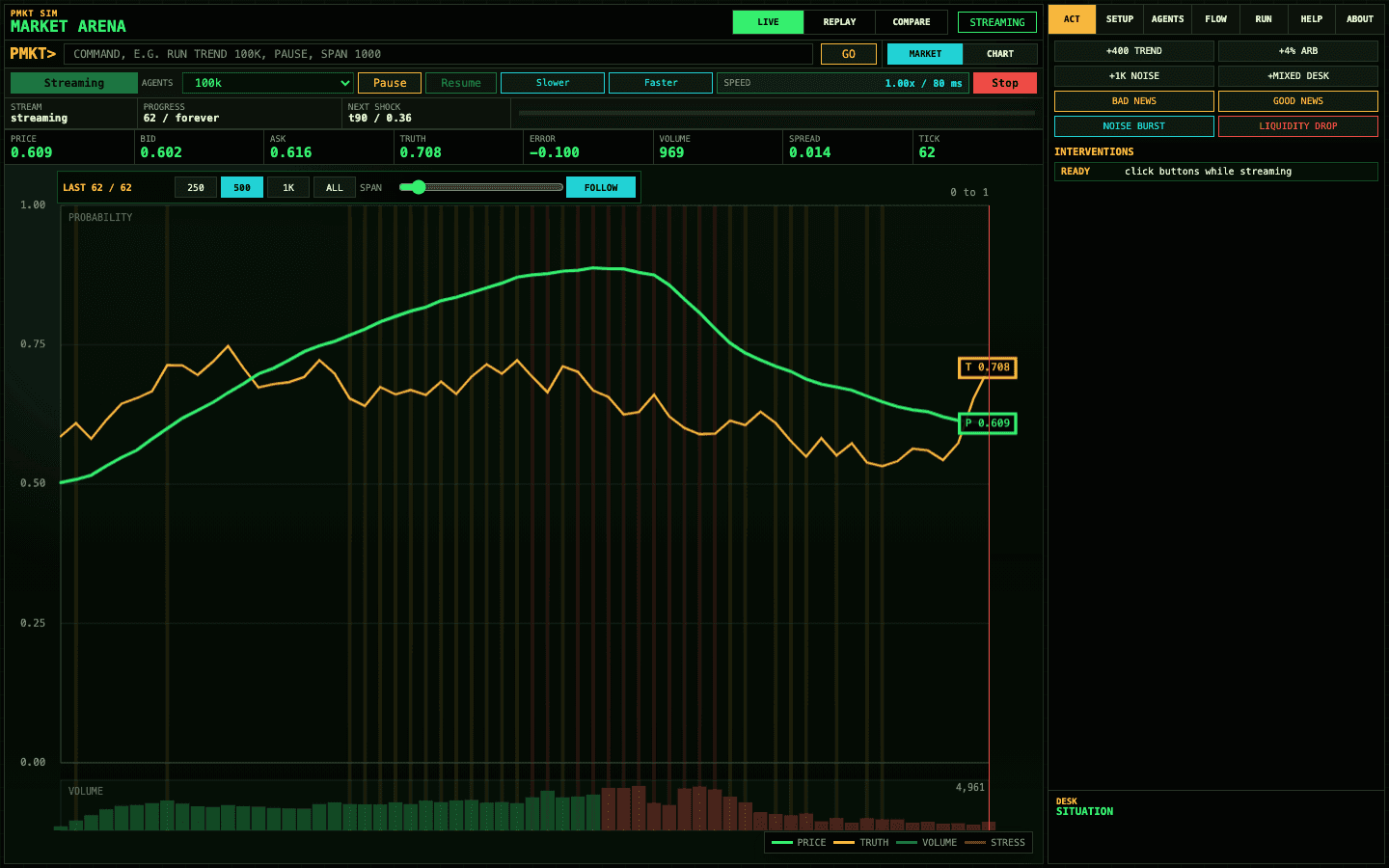
I built PMarket Arena because a prediction-market price is too clean. It compresses a messy social machine into one number between 0 and 1. That number can be useful, but it can also hide the most important story: who is trading, what they believe, how liquidity absorbs pressure, when shocks disturb the tape, and whether arbitrage has enough force to pull price back toward fundamentals.
The arena is my attempt to make that machine visible. It is not a replacement for the formal research pipeline. It is the public laboratory that lets a reader watch the mechanism move before reading the claim.
The Problem With a Clean Probability Chart
A clean probability chart is useful, but it can hide the causal story. A price at 0.62 could mean informed traders are converging on 62 percent. It could also mean trend followers are chasing a move, liquidity is thin, arbitrage is delayed, or one cohort is temporarily overwhelming the rest of the market.
The point of the arena is to ask a different question:
What kind of market produced this price?
A Market Is an Ecology
The core idea is simple:
The price is an output of the ecology. It is not the ecology itself.
In PMarket Arena, trader cohorts have different behaviors. Rational agents react to noisy signals about hidden truth. Trend followers react to recent price movement. Panic traders sell under stress. Arbitrageurs try to close price-truth gaps. Noise traders keep the market alive but can also blur the signal.
That mix matters. The same market with the same hidden truth can produce a very different price path if the cohort mix changes.
Why the Browser Matters
The research code can generate figures and metrics. The browser can create understanding. A live UI lets me add trader cohorts, inject a shock, slow the market down, inspect the pressure ladder, and ask what changed.
This is the move from figure to instrument. Instead of showing one finished result, the arena lets the reader interact with the system that creates the result.
Evidence Boundary
The browser arena is not the source of formal paper claims. The formal claims come from the reproducible Python pipeline, multi-seed experiments, logs, metrics, and claim audit. The browser arena is an explanation layer and scenario lab.
That separation is deliberate:
research pipeline -> evidence
browser arena -> intuition
Fieldworks post -> explanation
That separation keeps each claim tied to the right evidence surface.
What This Series Will Cover
This series follows the project in layers:
- Why known truth matters.
- Why trader composition comes before price.
- How the arena clears a synthetic market.
- When markets break.
- Why arbitrage is finite capacity.
- How the engineering stack supports reproducible research.
- How an interactive arena can make market structure legible.
The first technical step is measurement. If I cannot say what the price should have tracked, I cannot say whether the market was wise, noisy, or broken.