Interactive Simulation as a Research Interface
Why the next research interface is not only a paper, but a simulation readers can inspect, intervene in, and reuse.
Chuan August Sun · Institute of Lucidity
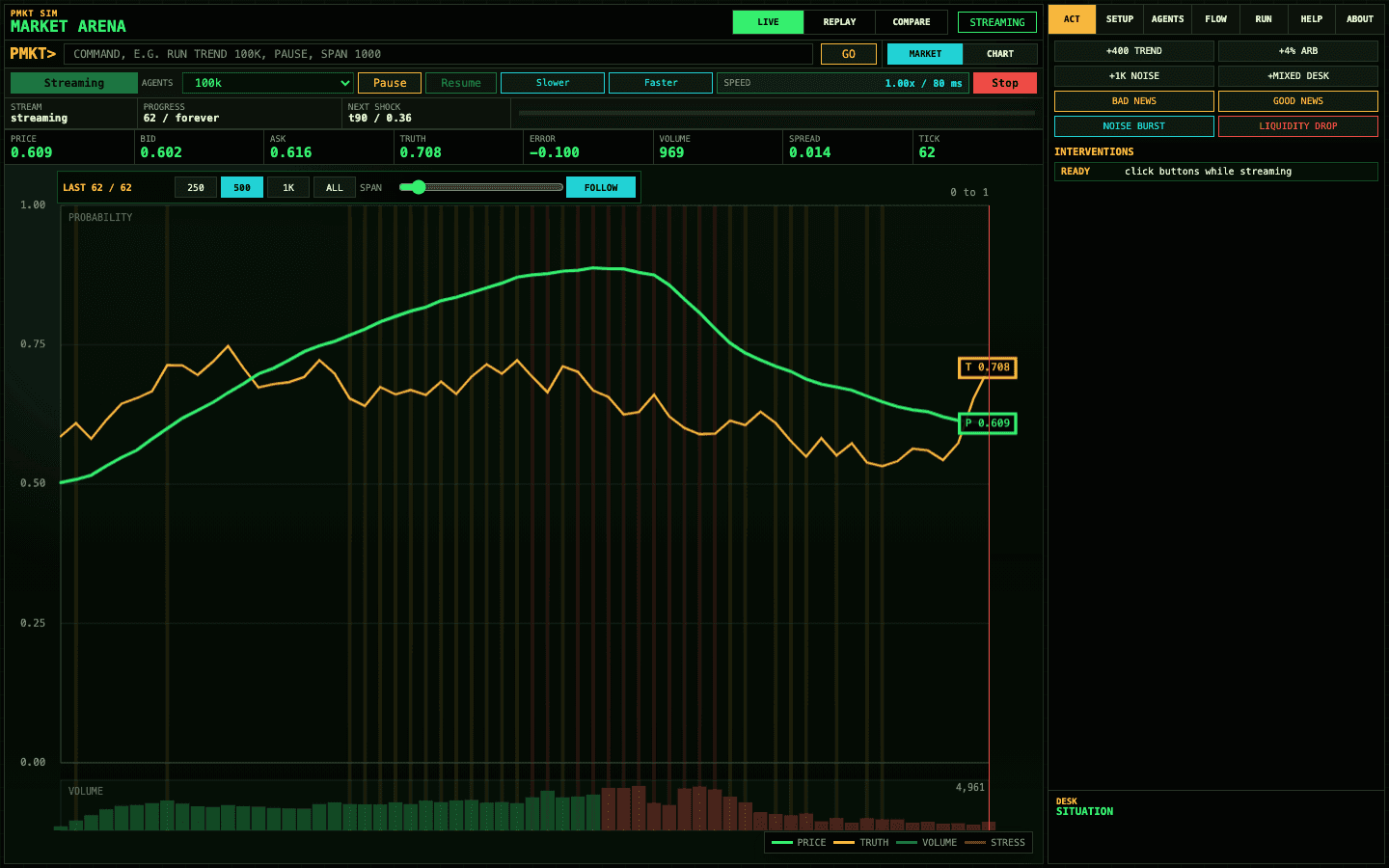
An interactive simulation can do something a static paper cannot do: it lets the reader intervene.
That matters for market-structure research because many of the important questions are causal. What happens if I add trend followers? What happens if arbitrage capacity arrives after a shock? What happens if liquidity drops while panic traders are active?
From Reading to Intervening
A static chart says what happened in one run. An interactive arena lets the reader ask what would happen under a nearby condition.
This is not the same as proof. It is a different kind of interface:
paper: here is the evidence
arena: here is the mechanism you can inspect
The two should support each other without collapsing into each other.
The Controls Are the Argument
The most important UI controls are not decorative. They encode the theory:
- population sliders express trader composition,
- shock controls express external information arrival,
- speed controls express the need to inspect dynamics,
- replay controls express reproducibility,
- commentary expresses interpretation discipline.
If a concept matters to the theory, the UI should make it visible.
Public Education and Product Imagination
The arena can teach prediction-market dynamics to people who will never read a manuscript. It can also help product designers reason about market controls, liquidity, participant behavior, and intervention timing.
But it should keep its claim boundary:
simulation insight is not live-market evidence
UI intuition is not regulatory readiness
product imagination is not a production claim
That boundary keeps the interface useful: readers can see which claims come from simulation, which require live-market evidence, and which remain design hypotheses.
The Fieldworks Role
Fieldworks should use the arena series as a public research interface. The goal is not to publish isolated posts. The goal is to build a durable body of work around market structure, AI agents, prediction markets, and simulation tools.
The series can become a template for future research programs:
- build the instrument,
- explain the math,
- publish the evidence,
- expose the interface,
- keep the boundary clear.
That is the larger Fieldworks pattern I want: rigorous enough to earn trust, interactive enough to teach, and reusable enough to become infrastructure for the next paper.