Arbitrage Is Capacity, Not Magic
Why correction pressure can be right in direction and still fail in size, speed, capital, or timing.
Chuan August Sun · Institute of Lucidity
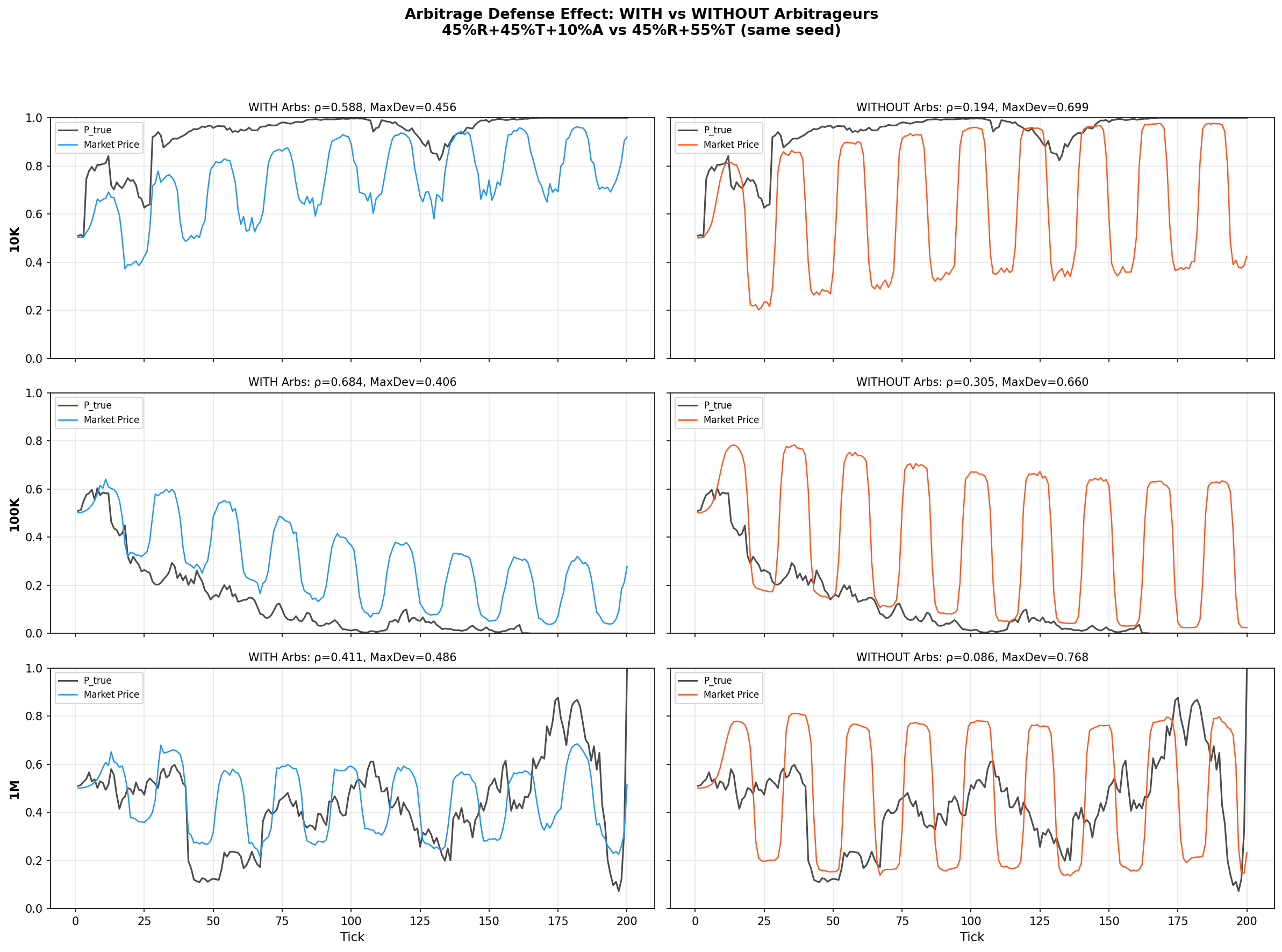
Arbitrage is often described as if it automatically fixes markets. That is too magical. In real market systems, correction is capacity: size, speed, capital, risk limits, latency, and confidence.
PMarket Arena makes this visible. You can add arbitrageurs and watch whether correction pressure is strong enough to pull price back toward truth.
Correction Can Be Right and Still Fail
An arbitrageur can be directionally right but still fail to restore the price quickly. The correction can be too small. It can arrive too late. It can be overwhelmed by trend pressure, panic pressure, or liquidity stress.
That is why the interesting question is not only whether arbitrage exists. The question is whether correction capacity is large enough at the moment it is needed.
A Simple Capacity Ratio
One way to read the arena is through a correction share:
Where:
D^A_tis arbitrage demand,D^T_tis trend pressure,D^P_tis panic pressure,D^N_tis noise pressure.
If correction share is low during stress, price can drift even when the market contains rational agents.
The Arena Intervention
The most direct demo is simple:
- run a balanced market,
- inject bad news,
- reduce liquidity or add trend crowding,
- add arbitrage capacity,
- watch recovery time and tracking error.
This is a public explanation of limits to arbitrage. It is not a proof that any real venue will behave the same way. It is a mechanism demonstration.
Design Implication
Market design should not assume that arbitrage will always clean up noise. It should measure correction capacity, quote depth, latency, capital concentration, and source-finality timing.
That lesson carries directly into prediction-market product design. A useful market is not only a market where someone could correct the price. It is a market where correction can arrive with enough force before the signal degrades.
That product lesson only matters if the research system itself is reproducible. The next layer is the engineering chain that turns a simulation into evidence.