Prices Against Known Truth
Why final outcome is not enough, and why a useful market lab needs a hidden truth path to judge price discovery.
Chuan August Sun · Institute of Lucidity
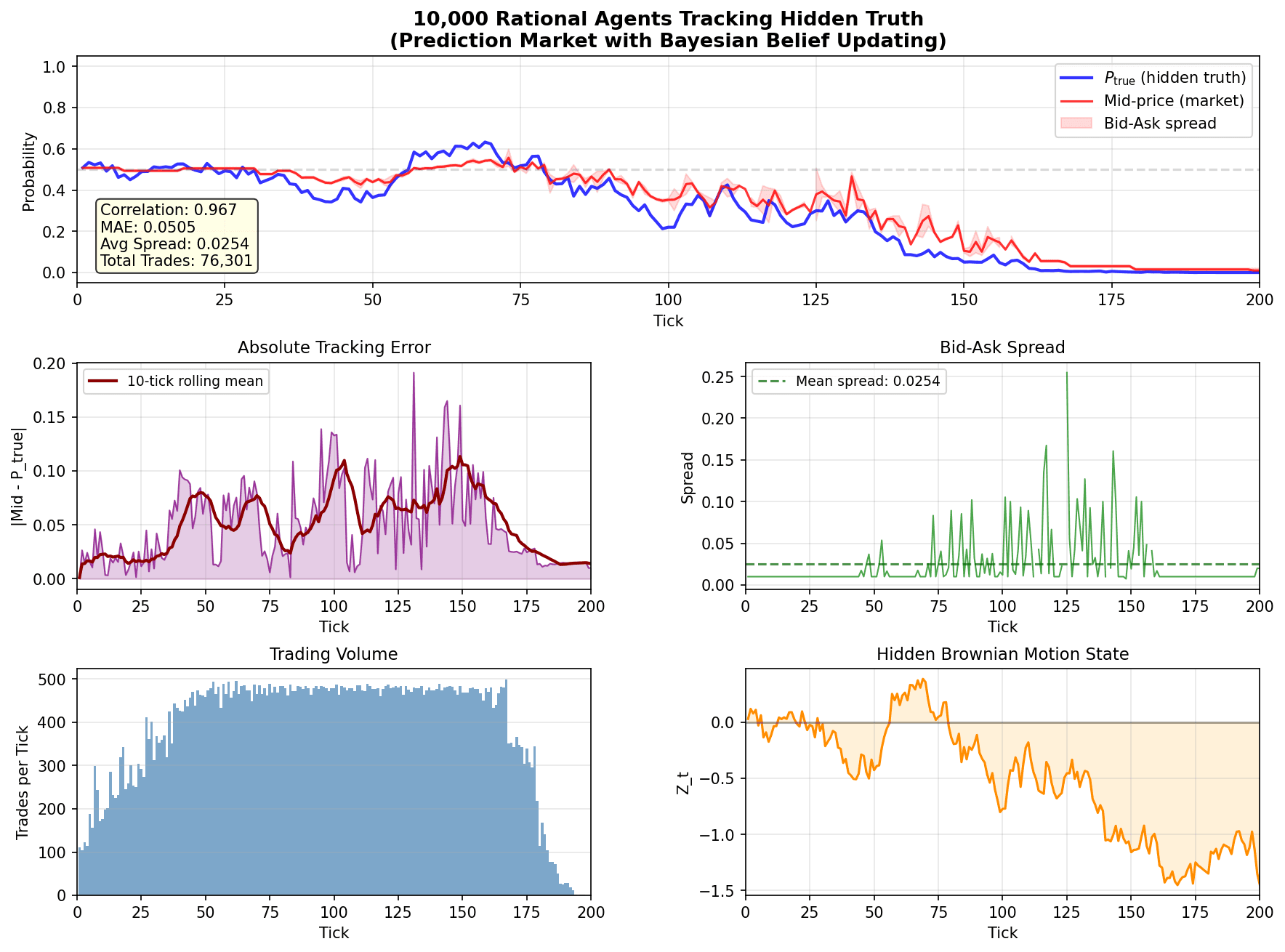
The hardest part of studying a live prediction market is not the final outcome. It is the path. After resolution, we know whether the event happened. While the market is trading, we usually do not know the correct probability at each moment.
That is why PMarket Arena starts with a hidden truth process. The simulator creates a latent probability path, gives agents noisy views of it, and then asks whether market price tracks the truth instead of merely ending on the right side.
Final Outcome Is Not Enough
Suppose a contract resolves to 1. That tells us the event happened. It does not tell us whether the market price at tick 40 should have been 0.54, 0.62, or 0.71.
This matters because market failure is often an interim phenomenon. A market can eventually settle correctly while still becoming misleading during the path.
The arena solves this measurement problem by creating a truth path we can inspect.
The Latent State
The research simulator uses a hidden state:
The true probability is derived from that state:
The market never gets this value directly. Agents receive noisy signals. They update beliefs. Then the market mechanism turns beliefs into price.
What Healthy Looks Like
In the rational baseline, agents receive noisy information and update beliefs in a disciplined way. The market price tracks the hidden probability path with high fidelity.
That baseline is important. Before we can study failure, we need to show that the same system can work.
The research question is not "can the simulator make prices look bad?" That would be easy. The research question is more precise:
When does a market that can aggregate information stop aggregating information?
Measuring Failure
The simplest failure measure is tracking error:
Across a run, we can measure:
- mean absolute error,
- correlation between price and truth,
- high-error duration,
- volatility,
- recovery time after shocks.
These metrics let us distinguish noise from persistent failure.
Why This Matters for Real Markets
Real prediction markets do not expose interim truth. That does not make them useless. It means we need indirect diagnostics: liquidity, spread, depth, signed flow, maker share, participant composition, and source timing.
Simulation gives us the laboratory where we can test those diagnostics against known truth. If a diagnostic fails in the lab, it should not be trusted in the field.
Once truth is measurable, the next question becomes sharper: which kinds of traders help the market track it, and which kinds make the price chase itself?